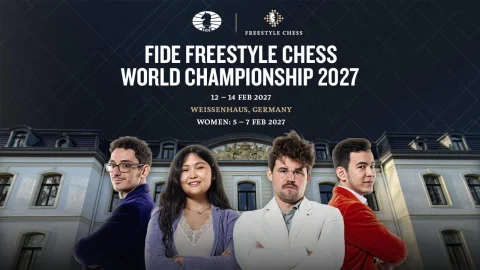


Women FIDE Freestyle Chess World Championships 2027
Chess in Las Vegas has hosted everything from Fischer rumors to World Championships, from youth blitz tournaments to celebrity showdowns. Vegas combines the cerebral with the spectacular. Whether amateur or World Champion, everyone finds a seat at the table. As chess keeps evolving, Las Vegas is its boldest stage.
Las Vegas was a small railroad town in the early 1900s. We can assume that chess made quiet inroads as an intellectual pastime amid the remote desert beginnings, though this has not been formally recorded. As the city began transforming into a casino and resort destination by mid-century, chess became a part of this transformation.
The first major chess event on record in Las Vegas occurred in 1952, when a part of the 16-game U.S. Championship match between Grandmasters Larry Evans and Herman Steiner was hosted there. The match, contested across multiple cities, saw its 13th and 14th game played in downtown Las Vegas – when Fremont Street was one of the only paved roads in town. Vegas was just beginning to grow beyond its early identity as a dusty railroad outpost.

In 1952, Herman Steiner (second from left) played a part of his U.S. Championship match in Las Vegas. One of the more colorful characters in American chess history, Steiner would have been a fitting match for the city that never sleeps – but instead, he opened a chess club in Hollywood.
By the 1960s, as Las Vegas boomed, chess organizers recognized the city’s potential as a venue. In 1965, Ed Edmondson – then Executive Director of the United States Chess Federation (USCF), a former military officer and one of the key figures in American chess – founded the National Open, establishing Las Vegas’s first recurring major chess event. The inaugural National Open set a high standard – no tournament in U.S. history had been run with more attention to player comfort. It earned a reputation as a “chess vacation,” where competitors could enjoy the city’s entertainment after their games.

Beth Harmon and Benny Watts in Vegas. | via Netflix
The cultural connection between Las Vegas and chess found fresh resonance through The Queen’s Gambit. In the series, Beth Harmon’s first high-stakes tournament takes place at the fictional Mariposa Hotel in Vegas – a setting that captures the scale, style, and sensory overload of the city in the 1960s. Though filmed in Berlin, the Mariposa evokes the grandeur of vintage Vegas: towering lobbies, gilded ornamentation, and the tension of ambition meeting spectacle. For Beth, the experience is formative – a first defeat to Benny Watts, but also a coming-of-age moment under the neon lights. It’s a reminder that Las Vegas has long been a place where where audacious characters and daring moves feel right at home.
In 1973, a Las Vegas hotel offered newly crowned World Champion Bobby Fischer an unprecedented $1 million (plus expenses) to play a single high-profile match. This ultimately fell flat when Fischer declined. But it signaled how Las Vegas was eager to “up the ante” in the chess world.
In 1976, the National Open became the first major tournament to ban smoking in the playing hall. The decision was controversial at the time and sparked debate among players – especially older participants accustomed to lighting up during tense moments. While some grumbled about losing what they saw as a traditional right at the board, the move marked a shift toward modernizing the tournament environment, prioritizing health and concentration – and set a precedent for future events.
In the early 1980s, the National Open returned to Las Vegas for good. After its inaugural edition in 1965, the event had wandered between locations – but in 1983, Fred Gruenberg anchored it permanently on the Strip. It began drawing hundreds of players from casual amateurs to grandmasters. Alan Losoff helped turn the National Open into “The Chess Vacation of the Year.” Gruenberg, a local entrepreneur with a passion for both chess and Las Vegas showmanship, and Losoff, a detail-oriented organizer with deep connections in the U.S. chess scene, were a perfect fit. Together, they professionalized the event’s logistics and atmosphere, laying the foundation for decades of successful editions rotating through iconic venues.

Together with Charlotte Hornets forward Grant Williams, Judit Polgar has just triumphed in the Chesstival Head & Hand tournament. For her, it marked a return to Las Vegas after more than 25 years. Back in 1999, she competed in the city’s first-ever World Chess Championship. | Photo: Lennart Ootes/Freestyle Chess
Las Vegas reached new prominence as a chess city in 1999 when it hosted the FIDE World Chess Championship knockout tournament at Caesars Palace. It featured 100 players. Judit Polgár, the first woman to participate in a world championship open to both sexes, made it to the quarter final. There, she lost to Alexander Khalifman who went on to become the new FIDE World Champion. Meanwhile, Las Vegas had proven itself a world-class host.
Though reigning champion Anatoly Karpov‘s planned participation in the 1999 FIDE World Championship fell through – he withdrew in protest after not being seeded directly into the final – his Las Vegas legacy runs deeper. Despite rarely playing serious chess in the city, Karpov was a regular visitor since the 1970s.
Negotiations for a high-profile match in Vegas against Bobby Fischer never came to fruition, nor did a proposed match against Susan Polgar, which was to include games in what was then only called Fischer Random and is now known as Freestyle Chess. Still, the maestro kept returning. Karpov watched Mike Tyson fight in Vegas, heard Frank Sinatra sing, and seemed genuinely drawn to the city’s atmosphere.

Frank Sinatra and Anatoly Karpov in Las Vegas 1979.
Las Vegas is the global capital of poker, and it’s no surprise that several strong chess players have crossed over. Poker and chess reward patience, calculation, and psychological insight – and in Las Vegas, those skills can shine under the same bright lights.
Few illustrate the crossover better than Dan Harrington – a National Master who won the 1971 Massachusetts State Chess Championship before becoming a World Series of Poker (WSOP) champion in 1995. Harrington authored a landmark book series on poker tournament strategy and was inducted into the Poker Hall of Fame.

Not every master stuck with chess: This 1975 photo from the Boylston Chess Club in Boston shows the club’s formidable A Team. From left to right: NM Marc Lonoff, GM Ken Rogoff (who would later become a world-renowned economist), NM Larry Tapper, FM Chris Chase (seated), NM Dan Harrington, and IM Norman Weinstein. Harrington went on to win the World Series of Poker and became famous as “Action Dan” – an ironic nickname, given his famously tight and conservative playing style. | via boylston-chess-club.blogspot.com
Jennifer Shahade, a two-time U.S. Women’s Chess Champion, has also made her mark on the poker tables. As a PokerStars ambassador and commentator, she blends her expertise in both games to promote mind sports.
Eloi Relange, once a rising French grandmaster, transitioned into poker and founded Poker Académie – France’s largest online poker school. Today, he is the president of the French Chess Federation – another case of someone straddling both worlds at the highest levels.
In the 2000s, Las Vegas fully embraced chess tourism. The Las Vegas International Chess Festival, built around the National Open, added the U.S. Women’s Open, scholastics, blitz and simuls. Casinos prove welcoming hosts. Raffle prizes, side contests, and deluxe ballrooms give amateurs the red-carpet treatment. In Vegas, chess players feel like stars. And, of course, chess festival poker tournaments complement the chess schedule.

The National Open these days. | via Las Vegas International Chess Festival
In 2014, Maurice Ashley and Amy Lee launched the Millionaire Chess Open at Planet Hollywood with a $1,000,000 prize fund – the biggest in chess open history. Nearly 600 players entered. Wesley So won the first edition. In 2015, Hikaru Nakamura won the second.
The event brought a poker-style buzz to chess with knockout playoffs on “Millionaire Monday.” The format dazzled fans, but the high production and prize fund costs proved unsustainable. According to co-founder Maurice Ashley, the financial burden eventually became too great, especially without long-term sponsorship. The series ended in 2016 – but it proved again that Vegas can host elite, spectacle-driven chess.
Las Vegas continues to innovate with Freestyle Chess, launching its first U.S. Grand Slam leg in 2025 at Wynn Las Vegas. The event (July 16–20) features Magnus Carlsen, Hikaru Nakamura, Fabiano Caruana and others, with a $750,000 prize fund. Spectators will watch from ringside seats. The festival includes Chesstival, a celebrity event created by NBA MVP Derrick Rose, where basketball stars face off over the board.
Freestyle blends creative, skill-driven chess with high-end production to grow the game’s audience beyond its traditional core. 2025 marks the first major chess event in the Wynn. Players, organizers, and fans alike look forward to a week of unforgettable games and a front-row seat to the future of chess.

The stage for the Freestyle Chess Grand Slam Las Vegas is set. | Photo: Stev Bonhage/Freestyle Chess
You are currently viewing a placeholder content from X. To access the actual content, click the button below. Please note that doing so will share data with third-party providers.
More Information
