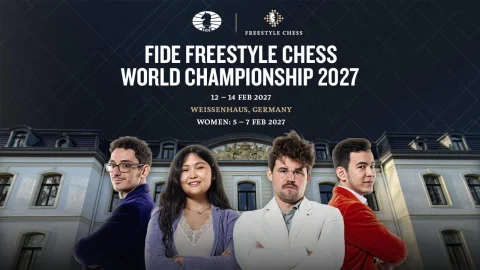


Women FIDE Freestyle Chess World Championships 2027
The penultimate day of the Freestyle Chess Grand Slam in Las Vegas ended with Magnus Carlsen and Hikaru Nakamura set to meet in Sunday’s third-place match – a repeat of their showdown in the Paris Grand Slam final, though this time with $160,000 and the last podium spot at stake rather than the title.
With Hans Niemann and Levon Aronian already through to the $340,000 Grand Final, the Wynn Las Vegas ballroom focused on the Lower Bracket battles today. Four players – Carlsen, Nakamura, Fabiano Caruana, and Praggnanandhaa Rameshbabu – began the day chasing a route back to the podium.
Carlsen’s journey began in dramatic fashion. After a chaotic first-round loss to Praggnanandhaa, the world number one ground down the Indian star to force tiebreaks and then reeled off five consecutive wins – including those over his next opponent Arjun Erigaisi – to reach the match for third.
Nakamura’s route was more steady by comparison. After drawing his opening classical game with Wesley So, he won a miniature to advance, then took down Caruana by winning both blitz tiebreak games after two tight rapid draws.
Sunday will feature these matches:

Once again there was plenty of reason for the audience to be on the edge of their seats. Photo: Lennart Ootes/Freestyle Chess.
This fourth day, with six hours of action the shortest so far, started with matchups between players already in the Lower Bracket paired with players who left the Upper Bracket yesterday. As the higher ranked player pre-tournament, Nakamura had the opportunity to choose his opponent first, and he went for So. The other matchup was Carlsen vs. Praggnanandhaa, with Arjun and Caruana waiting in the wings – they would step in later and could choose their opponents from the winners. There were no 30+30 games today; everything started straight from the 10+10 games.
All in all, the tournament is quite different from what we’ve seen in the Grand Slam before, and Weissenhaus winner Vincent Keymer, a guest in the studio today, reflected upon the changes: “I think the change of format also changed the tournament significantly. Now it’s more a rapid tournament; before we had a classical time control. Also, that we have only one day both for the round-robin and the matches changes a lot, because you don’t have time to come back. It’s all very sudden. Every mistake is punished incredibly, which basically means you can’t really come back. You can only come back with huge help. Also, it gives away a certain amount of control. I think the reason why I had such good results for example in Weissenhaus was because I was able to control the games and with this time control it’s incredibly difficult to do so or near impossible so you have to be a bit more used to chaos and do well there.”

Eliminated from the tournament, Vincent Keymer joined the broadcast today. Photo: Lennart Ootes/Freestyle Chess.
This fascinating clash started with an absolutely wild game, to be honest with the type of mistakes that suggest the players are getting pretty tired after several long days here in Las Vegas. Praggnanandhaa built up a big advantage and when Carlsen missed a simple pawn push, he felt obliged to give up his queen for just two minor pieces. That shouldn’t have been enough, but when the young Indian blundered a full piece, it was quite unclear again. Praggnanandhaa, however, recovered well from his mishap and gradually outplayed his opponent after all in a highly complex position with a strong material imbalance.

Carlsen resigns, Praggnanandhaa wins a crazy game. Photo: Lennart Ootes/Freestyle Chess.
Carlsen then won his must-win game smoothly in an endgame, in fact in similar style as how Praggnanandhaa had beaten Keymer the other day. The five-time world champion then won both 5+2 games, twice outwitting his opponent tactically in time pressure. Here’s the second:

Under time pressure, Carlsen was tactically the better player. Photo: Lennart Ootes/Freestyle Chess.
This match was a shorter affair, with Nakamura going through fairly easily. That was mostly the case because of what happened in game two. After a draw in their first 10+10 game, he defeated his compatriot remarkably quickly. As it turned out, the opening position was a very tricky one for Black and according to the engine, White’s 1.e4 could only be answered by one move to avoid a disadvantage, which was the symmetrical 1…e5. So went for the “Sicilian” 1…c5 instead and moved his e-pawn soon after, but that left a hole on d5. Somehow, he found himself in a completely lost position after just 11 moves. Or, as commentator David Howell put it, “strategically and dynamically busted.” Freestyle can be tough!

A nightmare opening for Wesley So, who never had a chance in game two. Photo: Stev Bonhage/Freestyle Chess.
The next half of the day saw the winners of the first two matches meeting the other players from the Upper Bracket. From the studio, Keymer noted that he wasn’t so sure if it was better to have to play (and win) a match first or wait as a spectator: “The winner at least brings positive energy and also you can argue that the other players had time to rest, but you shouldn’t that being in the fighting mood, or like, ‘in game,’ really can help. They are already warmed up.”
The first game in this next all-American matchup showed more signs of fatigue, mostly for Caruana, who had to go all the way to Armageddon earlier in the tournament. He was much better for most of the game and at two points clearly winning. First, he somehow avoided a tactic that the position was screaming for. Vidit Gujrathi, who joined the broadcast, explained it as follows: “I have a feeling Hikaru’s body language discouraged Fabi and he did not think that there was something. Hikaru bluffed his way there.” Nakamura then held a pretty good pokerface at the very end, as Caruana repeated moves in what was also a winning position.

A narrow escape for Nakamura in the first game. Photo: Stev Bonhage/Freestyle Chess.
As the second game ended in a draw as well, the players moved to two 5+2 games. With the pace going up, the general consensus was that Nakamura was now the slight favorite, and he delivered. The final phase of the first tiebreaker game was played with just seconds on the clock for both players, when neither player really knew anymore what was going on as the pieces were flying over the board, and Caruana eventually made the last mistake (see below). Nakamura then also won the second game convincingly.

Another impressive day for Nakamura, who will now play for third place. Photo: Lennart Ootes/Freestyle Chess.
Vidit’s remark from yesterday that top players are “like hungry sharks who just jump on you, and they don’t give you another chance” ringed true once again in this match. In a very quiet position in the first game, one small inaccuracy by Arjun was enough for Carlsen to get a chance, grab it, and use it to full effect. “It’s quite instructive how Magnus is handling the setting, this is his forte, this is the expertise,” said Vidit. “I’m just here to enjoy how he’s playing!” It was one of those games where it was hard to understand where Arjun went wrong. A positional masterpiece.
Arjun got a better position out of the opening in game two, but then messed it up, and Carlsen won again, his fifth consecutive win in the tournament. This set up an always exciting Carlsen-Nakamura clash which, to many fans, would have been a dream final. This time, they will be playing for third place. There’s money on the line as well as Grand Slam Tour points, which will be relevant at the end of the year.

Nakamura and Carlsen will meet in the match for third place. Photo: Lennart Ootes/Freestyle Chess.
Arjun and Caruana will now play for fifth place while the losers of the first matches of the day, Praggnanandhaa and So, will play a match for seventh place. And, we shouldn’t forget, Levon Aronian and Hans Niemann will take the main stage for the Grand Final!
You are currently viewing a placeholder content from X. To access the actual content, click the button below. Please note that doing so will share data with third-party providers.
More Information
